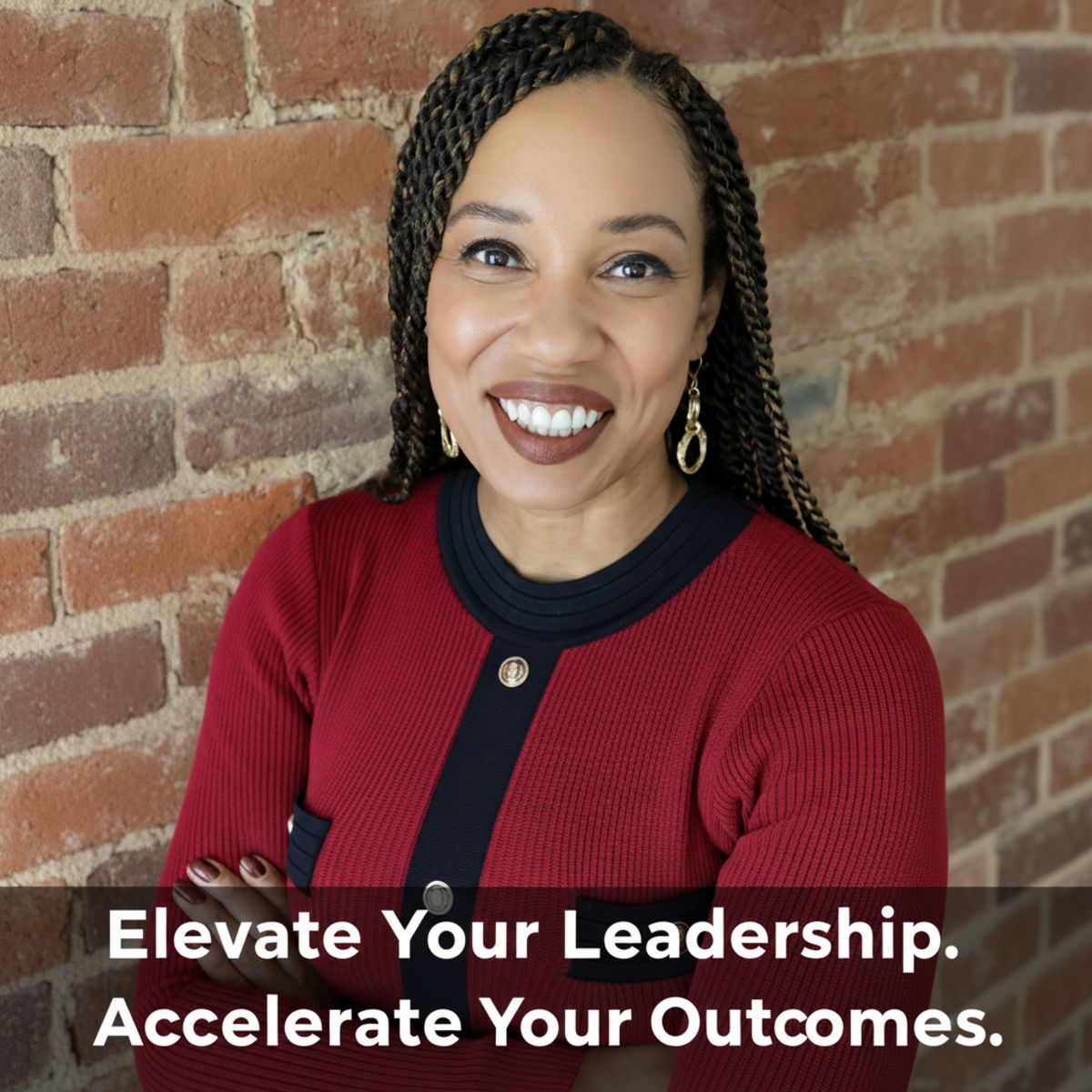

Teddra Burgess | 📬 LAUNCH ISSUE #1
Most founders, executives, and scale-up leaders I meet are exceptional builders.
They're adding revenue lines. Launching products. Hiring teams. Executing initiatives. Moving fast, breaking things, iterating. And that's exactly what got them here.
But the skillset that gets you to $10M won't get you to $100M. The tactics that made you Director won't make you VP.
The leaders who scale don't stop building; they evolve into architects. They layer structural thinking onto their builder instincts. They design systems that multiply their impact rather than just adding to it.
And in the AI era, where the pace of change is exponential and the cost of structural mistakes compounds daily, the difference between building tactically and architecting strategically is the difference between growth that scales and growth that collapses under its own weight.
Growth without architecture
is just expensive chaos.
I'm Teddra Burgess, and I've spent 25+ years in the C-suite of companies like Google Cloud, HP, and Tanium—driving billions in revenue growth, scaling teams from zero to enterprise dominance, and navigating the precise moments where companies (and careers) either break through or break down.
Whether you're scaling a technology sales operation from $1M to $10M, positioning yourself for that VP role, or transforming your organization for AI native operations, you need more than tactics. You need a blueprint.
That's what this newsletter is about.
BUILDERS VS. ARCHITECTS
Builders focus on addition. More revenue. More headcount. More features. More initiatives.
Architects focus on integrity and specialize in seeing around corners. Does the foundation support what we're building? Are the systems designed for scale? Will this structure withstand stress?
Here's what this looks like in practice:
In Business Builder: Hires a sales team and expects revenue to follow Architect: Designs pipeline infrastructure, partnership model, and enablement systems FIRST—then hires the right team to execute a proven playbook | In Careers Builder: Takes on every high-visibility project to prove their worth Architect: Selectively builds a portfolio of outcomes that demonstrate strategic leadership, not just execution capacity | In AI Transformation Builder: Implements AI tools across the organization to "stay competitive" Architect: Fixes underlying processes first—otherwise you're just automating chaos at scale |
Here's the critical insight: you don't abandon building to become an architect. You integrate architectural thinking into how you build.
The strongest leaders I've worked with—the ones driving 90%+ growth, earning promotions ahead of tenure, transforming entire organizations—they do both. They execute with the urgency of builders AND design with the foresight of architects.
The difference? Architects ask three questions before they build:
Foundation: What underlying structure needs to exist first?
Scale: Will this work at 2X? At 10X?
Sustainability: Can this operate without me being the bottleneck?
Builders focus on completion. Architects focus on compounding.
The architecture determines whether growth compounds or collapses.
THE EXECUTIVE ELEVATION MODEL™: YOUR BLUEPRINT
Over two decades of building and scaling billion-dollar operations, I developed a framework that separates sustainable growth from expensive noise. I call it The Executive Elevation Model™, and it's built on five integrated pillars:
Strategic Clarity - Are you solving the right problem? Most execution failures are actually strategy failures in disguise. Growth architects define the outcome first, then reverse-engineer the path.
Execution Excellence - Strategy without execution is hallucination. But execution without strategic architecture is just expensive activity. The question isn't "are we doing things?"—it's "are we building what matters?"
Adaptive Leadership - The AI era doesn't reward rigid plans. Growth architects build structures that flex without breaking—teams that can pivot, systems that can evolve, leaders who create change rather than just react to it.
Sustainable Growth - Quarter-over-quarter wins mean nothing if you're burning out your team, eroding margins, or building technical/organizational debt. Architecture accounts for load-bearing capacity.
AI & Future of Work - This pillar is foundational to the model itself—it's the stress test for everything else. Can your strategy, execution, leadership, and growth model survive the compression of timelines and the elevation of expectations AI creates?
This framework is how I helped a division at Google Cloud achieve 90% year-over-year growth. It's how I'm helping an enterprise software company architect their path in a new market from $800K to $8M in 3 years—a 10X transformation. And it's how I help executives transform from strong performers to strategic leaders who create markets, not just compete in them.
GROWTH ARCHITECTURE IN ACTION
BUSINESS EXAMPLE: ENTERPRISE SOFTWARE FEDERAL EXPANSION When this enterprise software company came to me, they had a classic builder problem: great commercial product, federal interest, but no federal revenue engine. The instinct? Hire a federal sales team and start pitching. The architecture approach? Different. We started with the foundation that matters: relationships. My existing connections within their partner ecosystem gave us immediate access to the channel leaders who actually move federal deals. Build on proven infrastructure rather than creating new channels. Design the pipeline model for 18-24 month federal sales cycles BEFORE hiring sellers. Create the enablement playbook that turns commercial messaging into federal-compliant value propositions. The team we eventually hire won't be building from scratch—they'll be executing a tested blueprint. That's the difference between $500K and $5M. That's architecture. |
CAREER EXAMPLE: FROM PRODUCT MANAGER TO HEAD OF PRODUCT (IN PLAY) One of my Executive Edge coaching clients came to me as a Senior Product Manager—shipping features flawlessly, managing roadmaps brilliantly, but invisible to the executive team. The builder move? Launch more products, gather more customer feedback, hope someone notices. The architect move? Reposition the narrative. We didn't change what he did—we changed how he framed it. Feature launches became market positioning decisions. User research became competitive intelligence. Sprint updates became business impact dashboards that spoke the language of board-level strategy. Within six months, he went from "not on the radar" to final-round interviews for Head of Product in another division. Same company, completely different trajectory. The work builds on the same foundation. The architecture of how it's presented—and therefore perceived—is completely different. |
That's growth architecture: designing the structure that makes the outcome inevitable.
WHY THIS MATTERS NOW
We're in a moment of structural shift, not just incremental change.
AI isn't a tool—it's a redefinition of what's possible, what's expected, and what's valuable. The founders, executives and organizations that thrive won't be the ones who adopt AI fastest. They'll be the ones whose underlying architecture can absorb and amplify AI's capabilities.
If your strategy isn't clear, AI will execute the wrong things faster
If your processes are broken, AI will scale the chaos
If your leadership is rigid, AI will expose every structural weakness
This is why architecture matters. Building without blueprints isn't just inefficient—it's unsustainable.
WHAT TO EXPECT FROM THIS NEWSLETTER
This isn't motivational content. You don't need cheerleading—you need architecture.
Each edition of Executive Elevation will give you:
Architectural principles - The structural thinking that separates sustainable growth from expensive activity
Real-world blueprints - Case studies from my 25+ years scaling billion-dollar operations and coaching high-achievers through transformation
AI era adaptation strategies - How to stress-test your leadership, your business model, and your career trajectory for exponential change
Actionable frameworks - Tools you can implement immediately, whether you're scaling a sales team or positioning for the C-suite
Some editions will focus on business growth. Some on career architecture. Most will integrate both—because the executives who win don't separate their professional development from their business impact. They architect both simultaneously.
ONE QUESTION TO START WITH
Are you simply executing or are you architecting?
If you're working 60-hour weeks but can't point to 3-5 outcomes that will fundamentally change your business or career trajectory this year, you're executing without architecture.
If your team is executing flawlessly but revenue isn't scaling proportionally, you're operating without structural design.
If you're adopting AI tools but not seeing transformational impact, you're automating chaos instead of architecting change.
The good news? Architecture is learnable. It's a discipline, not a personality trait.
And that's what we're architecting here together.
DOWNLOAD: THE GROWTH ARCHITECTURE AUDIT
Want to know exactly where you stand? I've created a free diagnostic tool that evaluates your current approach across three dimensions: Business Growth, Career Architecture, and AI Transformation.
The Growth Architecture Audit gives you:
15 assessment questions across the three domains
Scoring framework to identify your builder vs. architect ratio
Specific action steps based on your results
Direct application of The Executive Elevation Model™
Take 5 minutes now. You'll have clarity on where to focus your architectural development first.
WELCOME TO EXECUTIVE ELEVATION
I'm Teddra Burgess—"Navigator" leader, board advisor, and Founder & Principal of Chasing Outcomes™.
Over 25+ years in the C-suite at Google, HP, and Tanium, I've built billion-dollar businesses and driven exponential revenue growth by focusing on what matters: outcomes that compound, not activity that collapses.
I help executives and organizations architect sustainable growth—whether you're scaling revenue, positioning for the C-suite, or transforming for the AI era.
This newsletter is your blueprint for outcome-driven leadership. Every edition. No fluff.
Let's architect something that lasts.
Until next time,
Teddra
WORK WITH CHASING OUTCOMES™
Executive Edge™ Coaching
Transform your leadership with personalized coaching grounded in The Executive Elevation Model™. Programs for senior ICs to C-suite.
Public Sector Edge™
Strategic federal, state & local market architecture. Market entry, partnership activation, champion development.
Fractional CRO / VP Sales
Strategic growth architecture without full-time overhead. Commercial & Federal expertise, go-to-market strategy, sales and leadership development.
Speaking & Events
Keynote speaker, panel moderator, workshop facilitator, and MC. Topics: AI-era leadership, federal market architecture, growth at scale.