

Teddra Burgess | 📬 ISSUE #14
You spend your whole career trying to prove you're ready for the next room.
It's easy to forget: someone is already watching how you handle the one you're standing in right now.
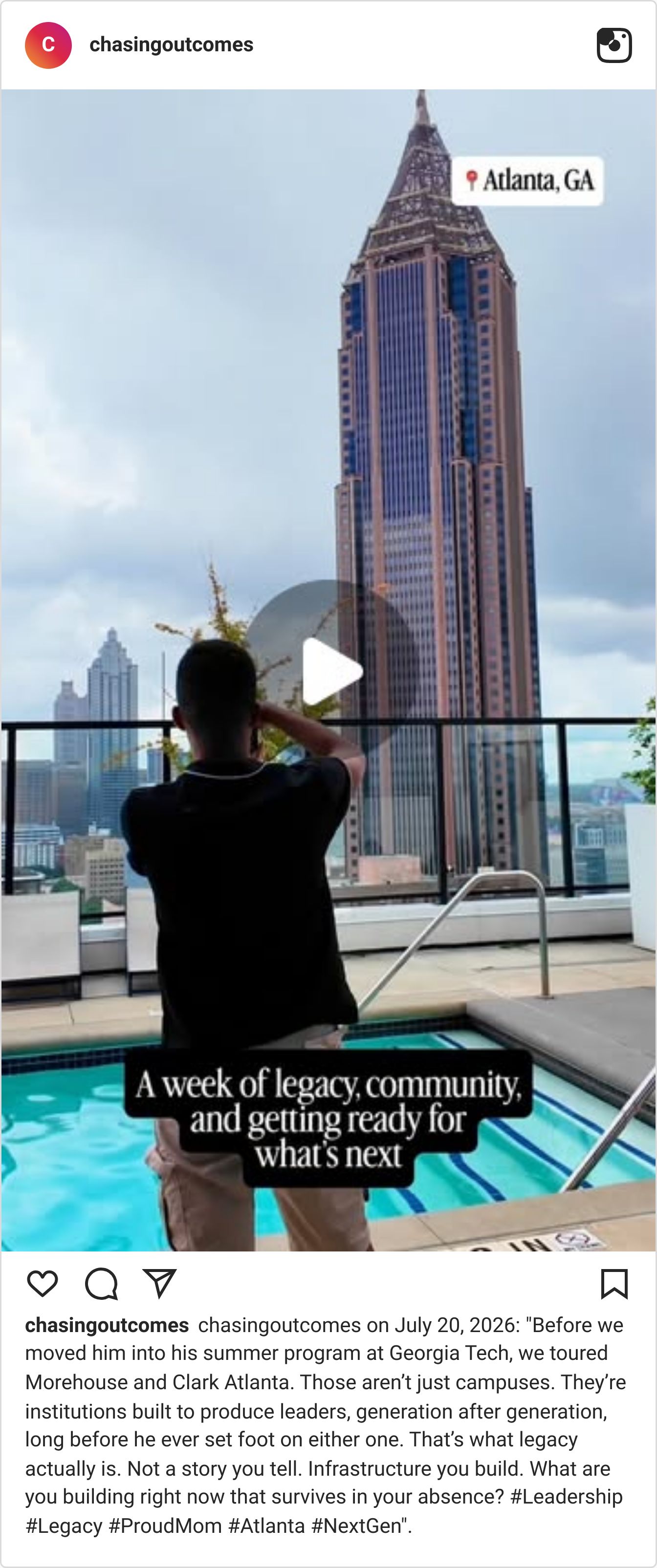
Last week I was in Atlanta with my son, a rising sophomore, there for a summer program for scholars in engineering at Georgia Tech. We toured Morehouse College. We toured Clark Atlanta University. On Saturday, in between all of it, my partner, Carlyle Chalmers, arranged for him to sit in on an acting class with a friend who runs a school there. Tuesday evening, he checked into the Georgia Tech program.
The acting class wasn't a requirement of anything. No resume value, no line on an application. It was the one room all week that wasn't built to prepare him for anything associated with engineering.
That's the moment that stuck with me harder than any campus tour.
I've coached leaders for years around one idea: capability isn't the constraint. But watching my son that week, I saw the deeper version of it. The next room doesn't just want more of what got you into this one. It wants something else entirely.
We also spent time with family and friends who've built careers you don't always learn about in a classroom: two airline pilots, a former Secret Service agent, a police officer. That's where the rest of this comes from.
The next level isn't a bigger room. It's a different one. And the leaders who excel aren't just more capable. They're more adaptable, more anchored, and clearer on what's actually at stake.
So I started naming the rooms I saw that week. Not a sentimental list. A map.
The Five Rooms
1. The Legacy Room. Morehouse and Clark Atlanta weren't just tour stops. They're institutions built to produce leaders, generation after generation, long before my son ever walked onto either campus. That's what legacy is: infrastructure. Values that don't change when the market does. A reputation that travels ahead of you. Neither school has to prove itself in the first meeting. It's already trusted before anyone walks in. That's the advantage most executives are still trying to build for themselves one room at a time.
The question: what are you building that still works when you're not in the room?
2. The Technical Room. The Georgia Tech program is where he'll build competence. But it's a different room than the one most of us walked into. Per NACE's spring 2026 survey, more than a third of entry-level jobs now require AI skills. Engineering still tops what Gen Z wants, at 17% in NSHSS's 2026 survey, but the entry point is more competitive and less forgiving of skill that can't be proven. The bar isn't "are you smart." It's can you build leverage without outsourcing judgment. That's not a talent gap. It's a proof gap. Fewer entry points means only the people who can already show their work make it through the door.
The question: can you direct the tools, or are you competing with them?
3. The Adaptive Room. The acting class; it was still part of the week, but it asked something different of him than the campus tours did. My son already has real stage presence when he's presenting. That's not the same thing as walking into a room built to expose you. He said yes anyway. He chose the discomfort before anyone made him choose it. That's a muscle most people don't develop until they're forced to, and it's the same one I watch senior leaders still trying to develop: being new again, being seen learning, taking feedback without taking it personally.
The question: where are you still optimizing for looking competent instead of getting more capable?
4. The Service Room. Two airline pilots. A former Secret Service agent. A police officer. None of them would call themselves a leader out loud. All of them have spent decades being the person other people's safety depended on. That's a different kind of pressure than a quarterly one. That's leadership measured in stakes, not title: calm under pressure, responsibility without applause.
The question: what are you responsible for that other people don't fully see, and are you building support around it, or just carrying it?
5. The Community Room. None of this week happens without Carlyle. A proud Clark Atlanta University Alum. His career as a writer, director, and producer put a lot of these doors in front of us, including that Saturday acting class. None of it happened because I pushed harder this month. It happened because someone already trusted, already established, opened a door I couldn't have opened myself. That's not networking. That's leverage you can't buy.
The question: who are you building with, not just performing for?
What to do with it
My son is walking into rooms this summer that will shape his skills. One of the clearest leadership lessons I've seen this summer came from a room nobody made him walk into.
That's true for the rest of us too. Name the room you're walking into next. What's changing about your scope, visibility, or stakes in the next 90 days? What's the new expectation nobody's written down yet?
Then look at the five rooms above and be honest about which one is under built right now. Not all five. One. Give it 30 days, and pick a single move: a standard you hold even when it costs you, an introduction you actually ask for, a room you walk into on purpose instead of waiting to be pushed.
Your map forward: take the Executive Edge Assessment
If you're not sure which room needs the work first, the Executive Edge Assessment is a 10-minute way to find out. Not a personality quiz. A diagnostic.

Closing Thought
Leadership doesn't skip a generation. It gets handed down on purpose, or it doesn't get handed down at all.
The leaders who last aren't the ones who chased the biggest room. They're the ones who build the capacity to walk into any room and still know exactly who they are.
Until next time,
Teddra
P.S. Connect with me on LinkedIN and if you like this newsletter, please share it with your friends and colleagues here.
WORK WITH CHASING OUTCOMES™
Executive Edge™ Coaching
Transform your leadership with personalized coaching grounded in The Executive Elevation Model™. Programs for senior ICs to C-suite.
Public Sector Edge™
Strategic federal, state & local market architecture. Market entry, partnership activation, champion development.
Fractional CRO / VP Sales
Strategic growth architecture without full-time overhead. Commercial & Federal expertise, go-to-market strategy, sales and leadership development.
Speaking & Events
Keynote speaker, panel moderator, workshop facilitator, and MC. Topics: AI-era leadership, federal market architecture, growth at scale.